Goals & Saving
Give your money a purpose.
Telling a child to "save your money" rarely works on its own. Saving becomes meaningful once there's something they actually want — something they can see, count toward, and eventually hold in their hands.
A child should be able to see, at a glance: how much they have, how much they need, how much they've already saved, and how much is still left to go. When all four of those are visible, saving stops being an abstract instruction and starts being a plan they can actually follow.
Why physical money matters
For younger children especially, real coins and a container to keep them in make saving something they can experience, not just hear about. With physical money, a child can:
- See exactly how much they have
- Touch and count their money themselves
- Watch their savings physically grow, jar by jar
- Understand that money is finite — there's only so much in the jar
- Physically feel money leaving them when they spend it
This is a practical approach, not a claim backed by formal research — it's simply what tends to make saving click for a young child.
Give saving a purpose
"Save your money" is vague, and vague instructions are hard for a child to act on. "Save for something you really want" is completely different — it gives saving an actual destination.
The goal should be something the child has chosen: headphones, a toy, a bike, a game, or even an experience like a day out. It doesn't need to be big — it just needs to be theirs.
Turn a want into a goal
A few simple numbers turn a wish into something a child can actually work toward.
Make the progress visible
Physical money makes the gap between "now" and "goal" something a child can actually see and count.
Learn through the purchase
The learning doesn't end when the goal is reached — the purchase itself is an important part of it. Handing over money they've saved themselves, physically, lets a child experience the full trade-off.
This isn't a claim that digital purchases can't teach anything — just that physical money can make the trade-off especially visible for a younger child.
Choices and trade-offs
Saving toward a goal is also a natural opening for simple questions, without needing complicated financial terms:
- "Do I really want this?"
- "Would I rather keep saving?"
- "Could I buy something cheaper instead?"
- "If I spend this money, how long will it take to save for my next goal?"
Saving is also about patience
Along the way, children pick up more than just a savings habit:
- Goals can take time
- Money doesn't appear instantly
- Saving means choosing not to spend, over and over
- Waiting can be worth it
- Reaching a goal feels different when you've worked toward it yourself
Our real-world approach
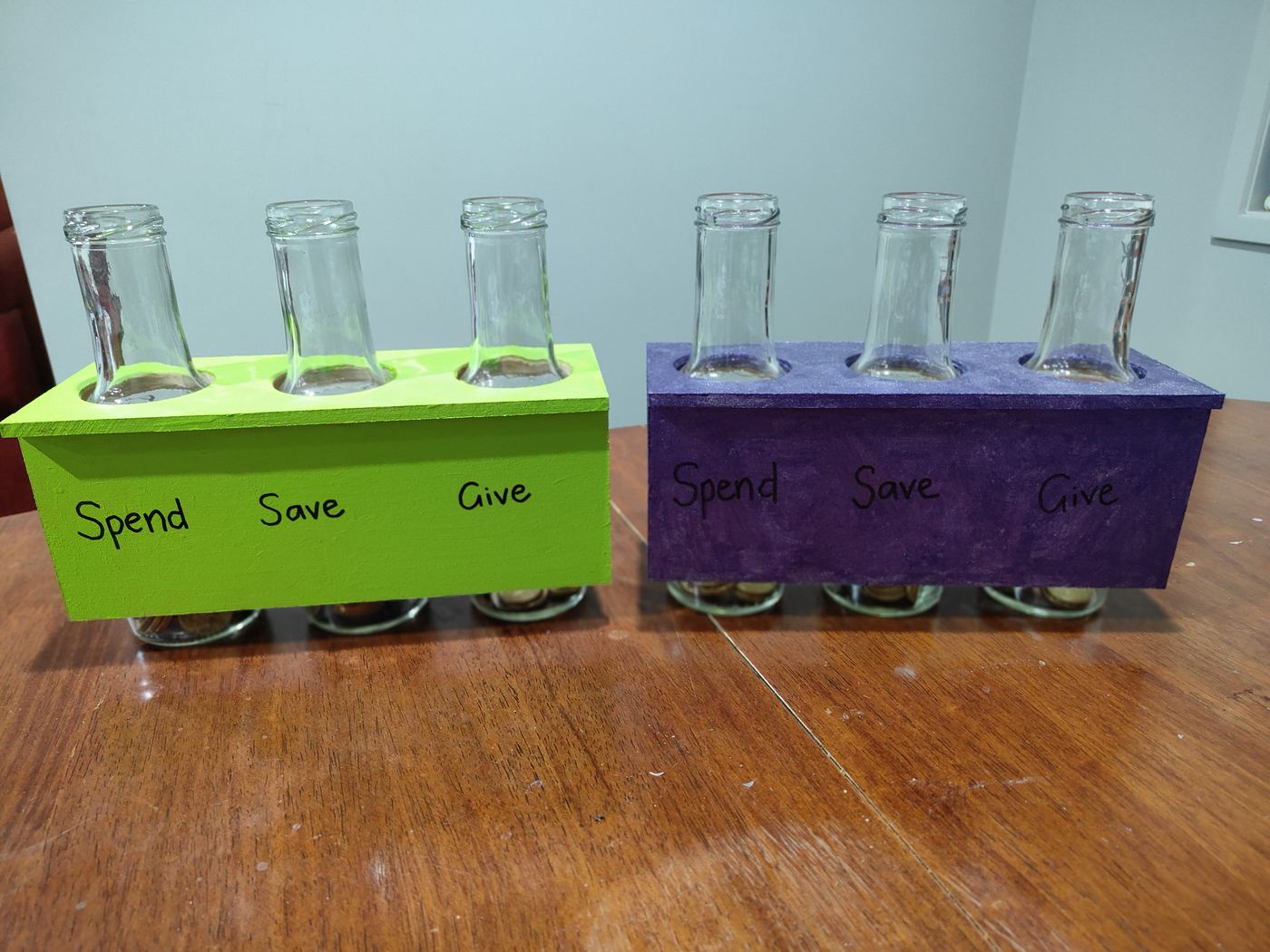
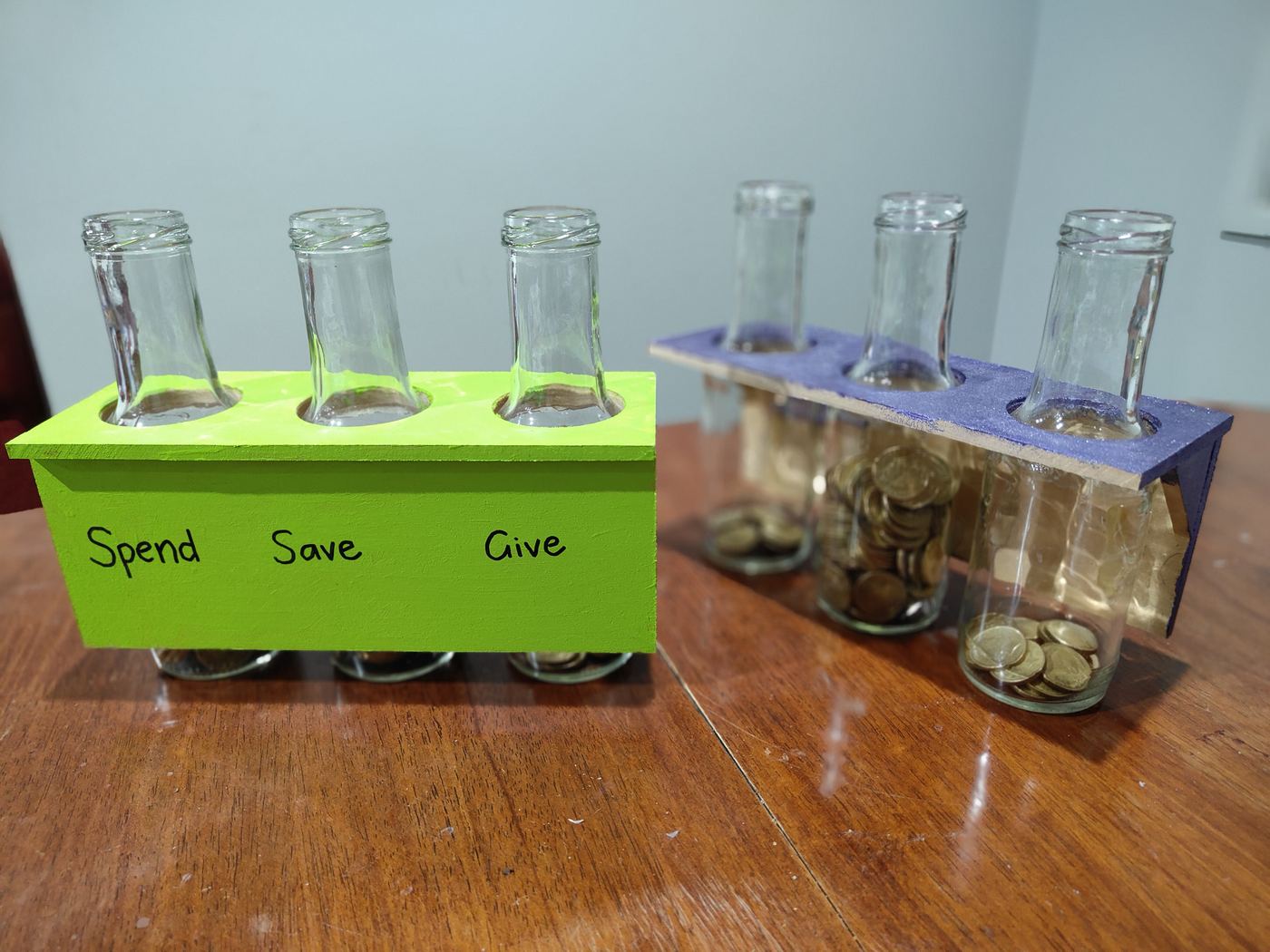
Each of our children gets $5 a week, paid in $1 coins: $2 into Spend, $2 into Save, $1 into Give. The Save money is reserved for a bigger goal the child has chosen — kept in a physical jar the kids made themselves, with a bit of parental help.
Physical first, digital later
For younger children, we start with physical money wherever possible. As children get older and start using bank accounts and digital payments, the idea can be introduced directly: a $1 coin is the same as $1 sitting in a bank account, which is the same as the $1 shown on a screen. It's still real money — just kept somewhere different.
From there, concepts can be introduced gradually: bank accounts, digital balances, interest, budgeting, more advanced savings goals, and eventually investing. This isn't a case against digital money — it's about building understanding in the right order.
A practical guide for parents
None of this needs to be complicated — here's roughly how we'd suggest starting.
- Get three small containers.
- Use real coins.
- Give your child a simple amount of pocket money.
- Create a Save goal.
- Let your child choose the goal, where appropriate.
- Let them count their money themselves.
- Let them watch the savings grow over time.
- Let them make age-appropriate spending decisions.
- Let them experience the purchase once the goal is reached.
- Gradually introduce digital money as they get older.
Frequently asked questions
Why use physical money with young children?
Physical coins let a young child see, touch and count exactly how much they have, watch it grow as they save, and feel it leave their hand when they spend it — all things a number on a screen can't do in the same way at that age.
What should children save for?
Something they've genuinely chosen and want — a toy, a game, a bike, headphones, or an experience. A goal the child picked themselves tends to mean far more than being told to "save your money" in the abstract.
How do I help my child set a savings goal?
Turn the want into numbers together: what it costs, how much they already have, and how much more they need. Writing or saying those numbers out loud makes the goal concrete instead of vague.
Should children be allowed to spend their savings?
Once they've reached their goal, yes — handing over the money they saved and receiving what they wanted is an important part of the lesson, not just the saving itself.
When should children start using bank accounts?
There's no fixed age. A common approach is to start with physical money while children are young, then introduce bank accounts and digital balances once they understand that the number on a screen represents the same real money.
How do I explain digital money to children?
Once physical money makes sense to them, you can connect the two directly: a $1 coin is the same as $1 sitting in a bank account, which is the same as the $1 shown on a screen — it's still real money, just kept somewhere different.
Want the full pocket-money system?
See exactly how we run Spend, Save & Give at home — real amounts, real jars, real routine.