Pocket Money & Teaching Kids About Money
A practical NZ parent's guide to helping children learn about spending, saving, giving and making their own financial decisions.
This is what works for our family — not the one "correct" way to do pocket money. Take what's useful and adapt the rest.
Financial education doesn't need to start with spreadsheets or a formal lesson. Some of the most useful learning happens when children handle small amounts of real money, make their own choices about it, and see what happens next — good or bad.
Here's what we do in our family: a simple three-jar system — Spend, Save and Give — built around a small weekly amount of pocket money for our two children, aged 8 and 10. It isn't the only way to approach this, but it's worked well for us, and it might give you a useful starting point for your own family.
The 3-jar method
Every dollar of pocket money goes into one of three jars, each with its own purpose.
Spend
Money the child can spend on what they like, with some parental guidance. We don't question normal, everyday spending decisions — the point is to practise actually making them.
Save
Money reserved for a specific, meaningful goal the child is actively saving toward — for us, that's been things like Bluetooth headphones. The purpose is learning to wait for something worthwhile.
Give
Money set aside for genuine charitable giving — things like Daffodil Day at school, or organisations that provide pyjamas for children in need. It makes generosity a real, concrete habit rather than an idea.
Our $5-a-week system
Each of our children gets $5 a week, paid in $1 coins, split like this:
We fill the jars in the order Give, then Save, then Spend — so giving and saving are never an afterthought once the Spend jar has already had its turn. Pocket money day is Sunday, and I get a roll of $1 coins from the bank ready in advance so it's never a scramble.
We use $1 coins on purpose. At this age, a pile of coins is easier to see, count and understand than a number on a screen — and it makes the weekly split genuinely simple to hand over.
Why we use physical coins and jars
There's nothing wrong with tracking pocket money digitally, but for younger kids, physical money makes a few things visible in a way a number on a screen doesn't:
- Money actually coming in each week
- Money being split and allocated on the spot
- Savings visibly growing in the jar
- Money leaving the Spend jar when it's spent
- Roughly how much is left to reach a goal, just by looking
We use tall, wide-mouth glass preserving jars — big enough to hold coins comfortably, but not so large that it takes forever for them to look like they're filling up. The kids made their own jars and holders themselves, with a bit of help, which made the whole system feel like theirs from the start.
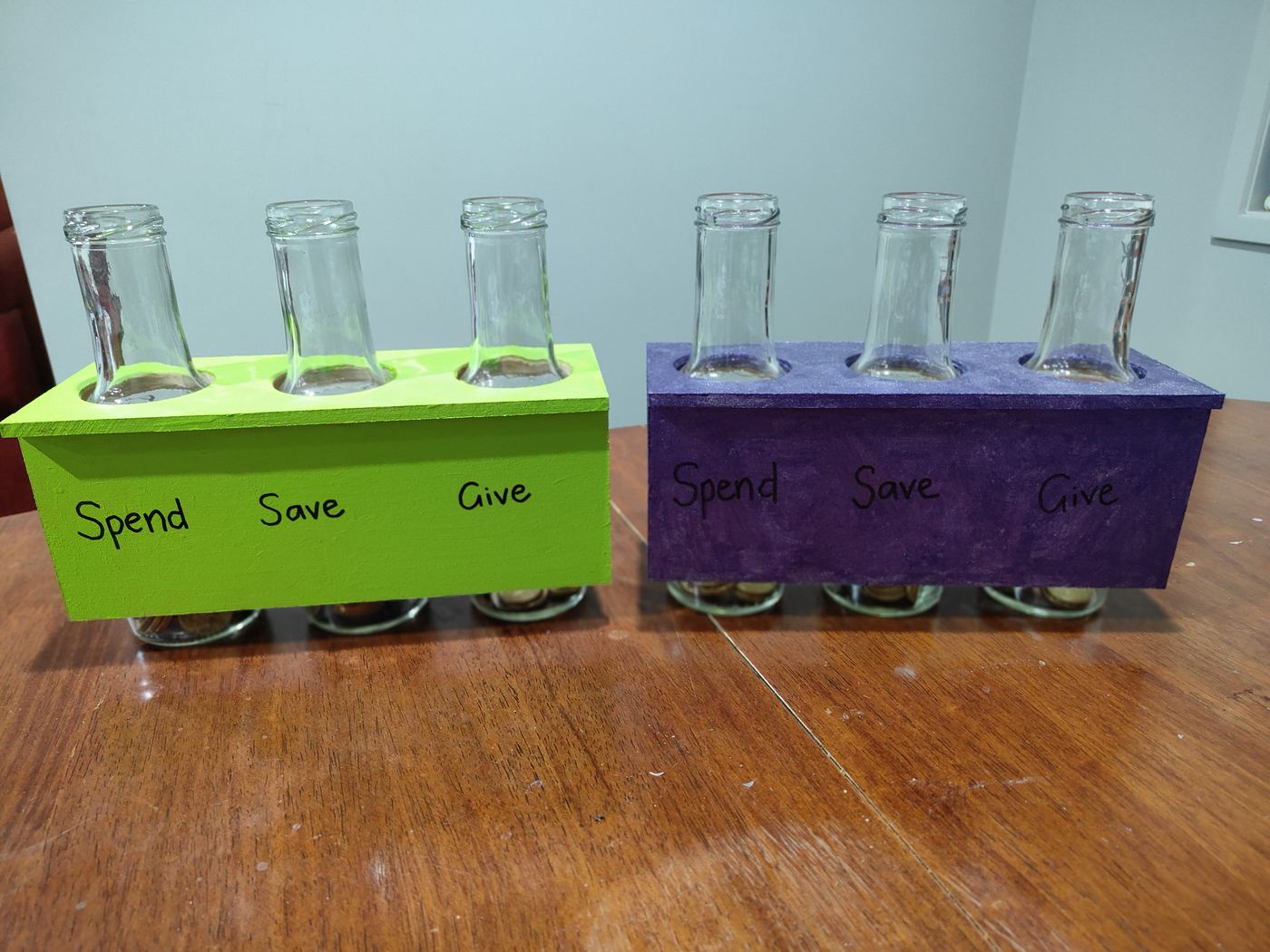
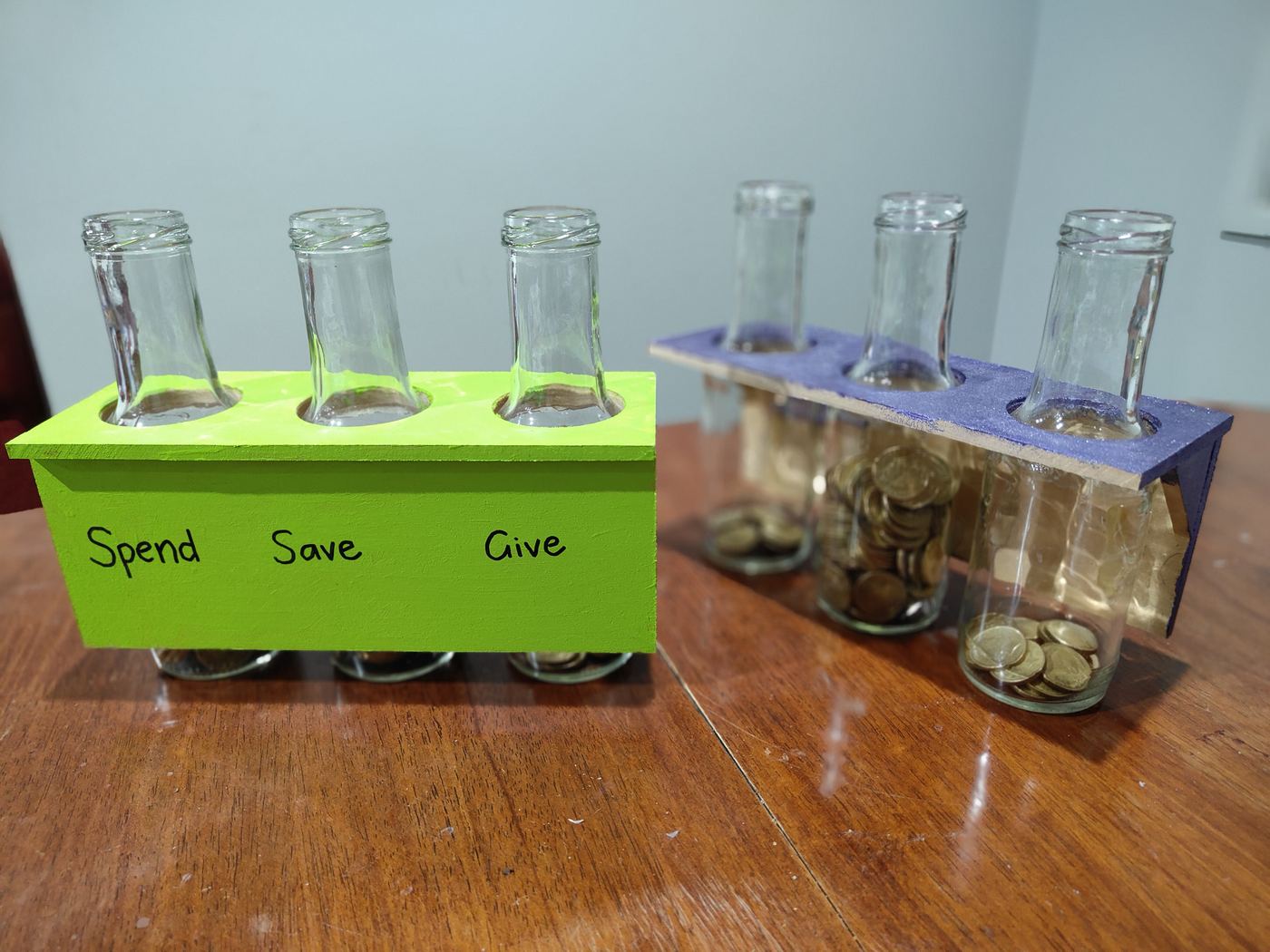
Saving for a goal
The Save jar isn't just "money you're not allowed to touch." For it to mean anything, it needs a specific goal — something the child has actually chosen and wants.
For us, that's been things like a set of Bluetooth headphones, or saving spending money for an overseas holiday. Once there's a real target, watching the jar fill up becomes meaningful in a way that an abstract instruction to "save some money" never is — they can see exactly how much closer they are each week.
Teaching interest
At the end of each month, we pay "interest" on whatever's sitting in the Save jar: for every $10 saved, the child gets $1. To keep it sustainable, we cap it at $5 a month.
This is a teaching mechanism, not real bank interest — the rate is deliberately generous, and no actual bank would pay it. It's meant to make an abstract concept concrete, not to model what a savings account actually pays.
What it introduces, in simple terms a child can follow:
- Saving is rewarded, not just "not spending"
- Leaving money untouched can make it grow on its own
- A first, simplified taste of how compound growth works — useful groundwork for later, more accurate lessons
- A concrete example to build on when explaining how banks actually pay interest
Pocket money and chores
In our house, a few regular jobs are just part of contributing to the household — currently that's the dishwasher, the blinds, and recycling. They're expected, not separately paid.
Bigger, optional jobs are different: washing the car, mowing the lawns, and similar bigger tasks can earn additional money on top of the regular $5. That distinction — ordinary contribution versus extra effort for extra pay — is simply what works for us; plenty of families draw that line differently, and there's no universally "correct" answer here.
Consequences
If money needs to be deducted — because of behaviour, or because an expected job wasn't done — it comes out of the Spend jar first, in our system.
The reasoning, for us:
- It creates an immediate, visible consequence, close to the behaviour
- It protects the Save jar, so a longer-term goal isn't undermined by a short-term issue
- It keeps giving intact, so generosity isn't caught up in a consequence
- The child can actually see the effect, rather than it being an abstract warning
Again, this is our family's approach rather than a rule we'd claim is right for everyone.
How to set up your own 3-jar system
None of this requires anything special — here's roughly how we'd suggest approaching it.
- Choose three containers — jars, boxes, envelopes, whatever you have.
- Label them Spend, Save and Give.
- Decide how much pocket money you're comfortable providing.
- Decide how to divide it across the three jars.
- Choose a regular payday, so it becomes a predictable routine.
- Help your child choose a specific savings goal, not just "save some money."
- Let your child make their own spending decisions with the Spend jar, mistakes included.
- Decide how charitable giving will actually work — a cause, an event, or something ongoing.
- Decide how chores and any extra paid jobs will work in your household.
- Review the whole system every so often and adjust it as your child grows.
Adjusting the approach for different ages
The same three-jar idea can flex a lot depending on your child's age and stage.
Young children
- Identifying coins
- Counting money
- The basic idea of Spend, Save and Give
Primary-school children
- Setting a savings goal
- Comparing prices before buying
- Making their own spending decisions
- A simple introduction to interest
Older children
- Basic budgeting
- Bigger, longer-term savings goals
- Bank accounts and real interest rates
- Opportunity cost, investing, and other bigger concepts
What we've learned
- Make money visible — physical coins and jars help, especially for younger children.
- Give every dollar a purpose, rather than leaving it undifferentiated.
- Let children make small spending mistakes — that's part of how the lesson lands.
- Make savings goals tangible and specific, not abstract.
- Make giving real, tied to an actual cause the child understands.
- Introduce bigger financial concepts through actual money, not just conversation.
- Keep the whole system simple enough that your child genuinely understands it.
If you're also looking for a clearer picture of your own household's budget — not just the kids' pocket money — our budget app for NZ households works on a similar principle: you stay in control of the numbers, and nothing connects automatically to your bank account.
Want a clearer picture of your own finances?
MyFinance helps NZ households track spending, budgets, debt, investments and net worth — no bank connection required.
Frequently asked questions
What age should children start learning about money?
There's no single right age — many families start once a child can count and understands basic ideas like "more" and "less," often around early primary school. Adapt the amounts and concepts to whatever age your child is at.
How much pocket money should I give my child?
This varies a lot by family and budget. In our house it's $5 a week per child, split across spend, save and give — but the amount matters less than being consistent and giving the child real decisions to make with it.
Should pocket money be tied to chores?
Families take different approaches to this. We treat a few regular jobs as a normal part of contributing to the household, and pay separately for larger, optional jobs — but there's no one correct answer, and it's worth deciding what fits your own family.
What are Spend, Save and Give jars?
They're a simple way to split pocket money into three purposes: Spend (money to use freely), Save (money set aside for a specific bigger goal), and Give (money set aside for charitable giving).
How do I teach a child to save?
Giving saving a concrete, specific goal — rather than just telling a child to "save some money" — tends to make it more meaningful, because they can see the balance growing toward something they actually want.
Should children be allowed to spend their pocket money freely?
In our system, yes, within reason — the Spend jar is about letting them practise making their own spending decisions, including the odd one that turns out to be a mistake. Other families prefer more guidance; it's a judgment call.
How can I teach children about interest?
One option is a simple, generous "family interest" rule on savings — for example, a fixed amount for every $10 saved, paid monthly. It isn't real bank interest, but it can help introduce the idea that money can grow when it's left alone.