Our 3-Jar Money System
"One of the simplest ways we've found to teach kids about money is to let them actually handle it."
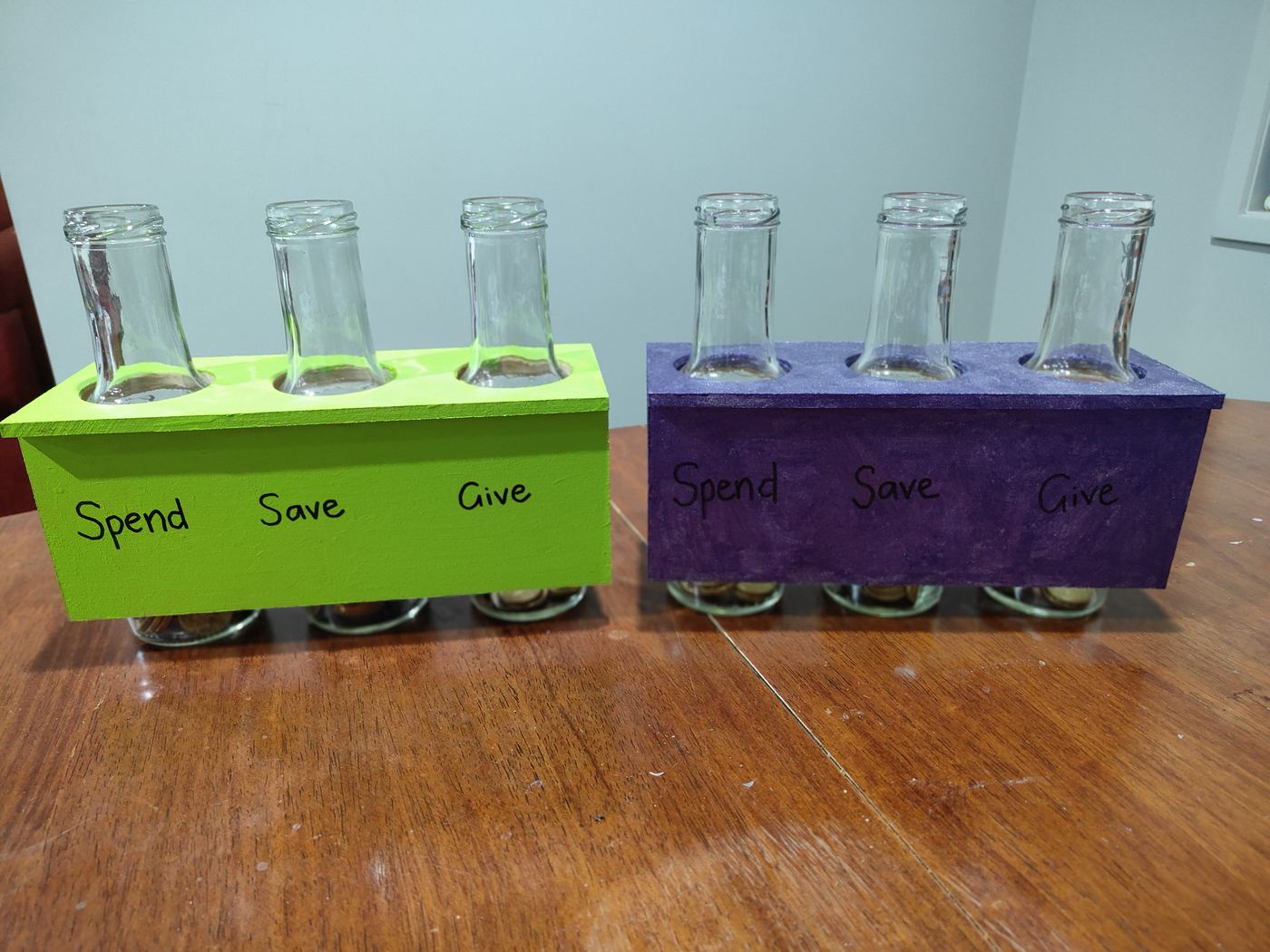
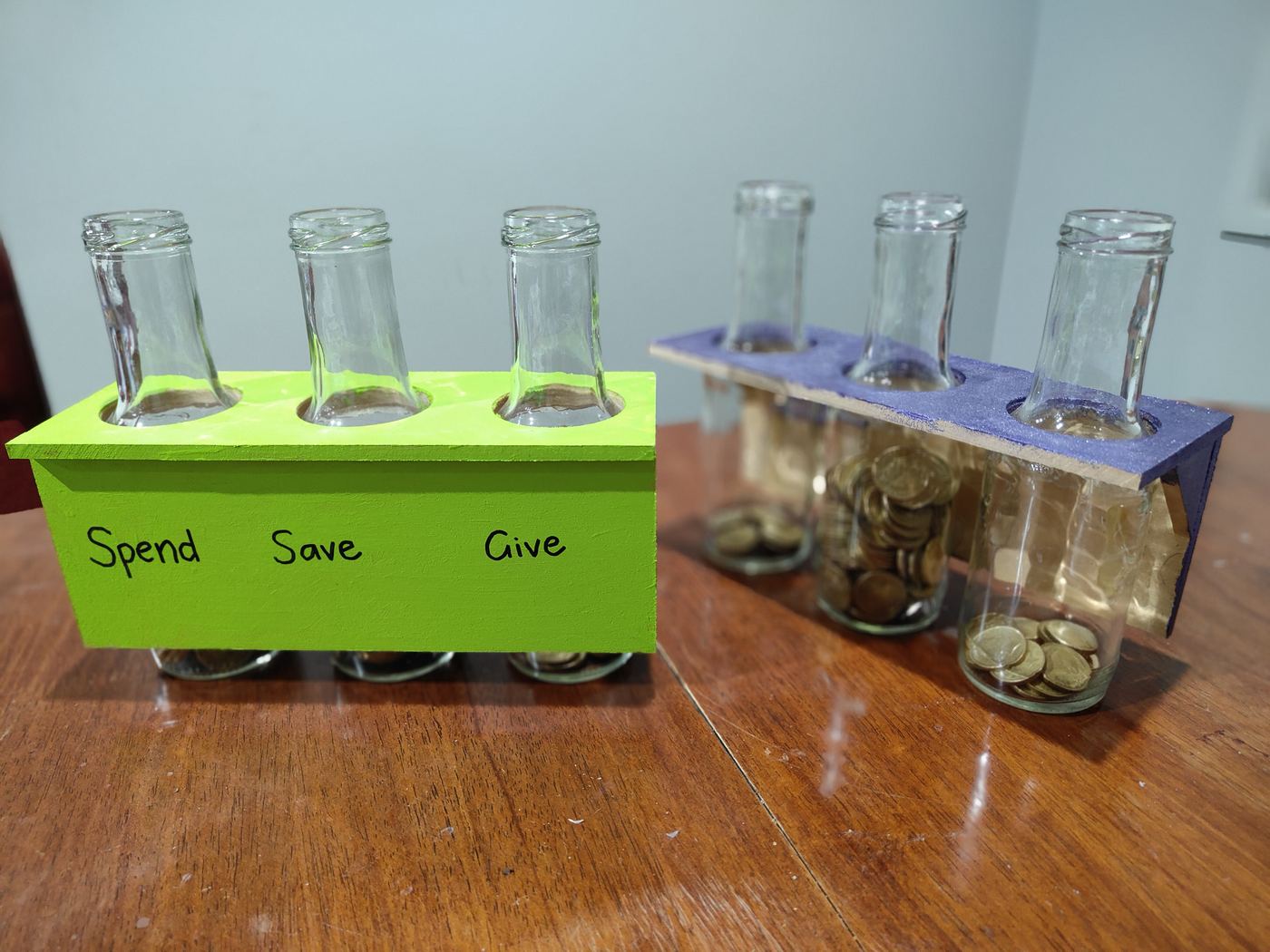
We use three physical jars — Spend, Save and Give — so our children have a simple, visible way to see where their money is going, and learn through real decisions rather than being told what to do.
$5, every Sunday
We use physical $1 coins — deliberately. Our kids can hold them, count them, move them between jars, watch their savings grow, and physically experience spending the money. None of that happens the same way with a number on a screen.
Spend, Save & Give
🛍️ Spend
Money the child can choose to spend, however they like. Once it's in the Spend jar, it's theirs to decide.
🐖 Save
Money reserved for a bigger goal the child chooses themselves — a toy, a game, headphones, a special activity.
Watching the coins build up makes progress visible in a way a bank balance rarely does for a young child.
💛 Give
Money set aside to give to others — charity, school fundraising, helping someone, a community cause.
It teaches that money isn't only about buying things for ourselves.
Why physical money?
For young children, we deliberately prefer physical money over digital balances. A number on a screen can feel abstract. A pile of coins feels real.
A child can see $20. They can hold $20. They can count $20. And when they spend $20, they can physically watch those coins leave. That creates a much stronger connection between money, saving and spending than a balance changing on a screen.
We're not saying digital money is bad — it becomes increasingly useful as children get older. We just think the foundation comes first.
Nothing fancy
You don't need special equipment. Three ordinary transparent jars are enough — the important part is that the money is visible.
Payday
We prepare $1 coins and distribute the $5 in a specific order.
Giving and saving happen before spending. The child sees that not all of their money is immediately available to spend — it's already been given a purpose before Spend is even touched.
Jobs
Children can have normal responsibilities without every task necessarily being paid. Our children have regular jobs that are just part of contributing:
We also have larger jobs that can earn additional money on top of pocket money:
Parents should decide what works for their own family — the purpose is helping children understand the connection between effort, responsibility and earning, not copying our exact list.
Consequences
If a financial consequence is needed, money comes from the Spend jar first. If a child needs to lose $2, that $2 comes from Spend — we generally protect Save and Give.
We want consequences to be meaningful without constantly undermining a child's savings goals or generosity. This is our family's approach, not universal parenting advice.
Saving interest
At the end of each month we reward saving: for every $10 in the Save jar, we add $1.
Otherwise we'd eventually go broke paying interest!
Children begin to understand that saving can be rewarded, money can earn money, patience has value, and leaving money alone can have a benefit. This is a teaching exercise, not a real-world bank interest rate.
If the interest itself stays in Save rather than being spent, it starts earning interest too — see how our family uses interest to introduce the idea of compound growth.
Saving for a real goal
Don't just teach children to save because adults tell them to. Let them choose something they actually want, then let them watch the money accumulate.
When they finally reach the goal, actually buy the item. The child has chosen the goal, saved the coins, watched the pile grow, made choices about spending, and finally given up the saved money — all of it real, none of it hypothetical.
"Saving isn't just about having money. It's about deciding what is worth giving your money up for."
There is no perfect system
Parents can change the weekly amount, the Spend/Save/Give split, the jobs, the consequences, the savings reward, and the goals. The important thing isn't copying our exact numbers — it's creating a system your own children understand and can participate in.